


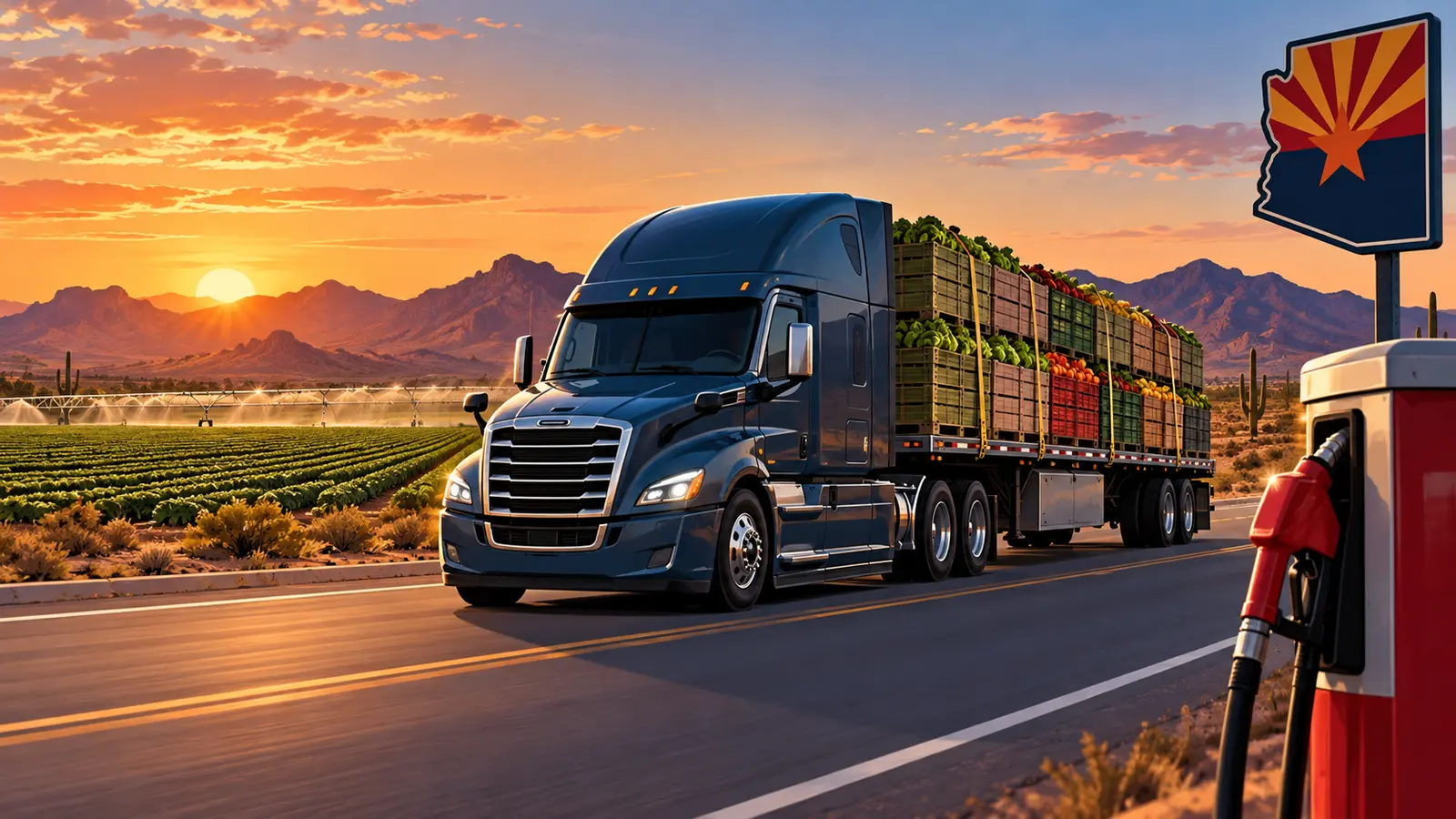
Arizona has declared a statewide diesel-fuel emergency and temporarily loosened two rules for agricultural transportation, a step aimed at reducing the cost of moving food and farm goods while fuel prices remain sharply elevated.
Executive Order 2026-03, signed by Gov. Katie Hobbs on Oct. 13, allows qualifying agricultural trucks to seek free permits for heavier loads on non-interstate highways. It also directs state agencies to deprioritize enforcement of restrictions on red-dyed diesel in qualifying agricultural vehicles through Dec. 31.
The changes could affect produce, livestock and farm-equipment movements feeding West Valley warehouses, stores and restaurants. The order does not promise a retail price reduction, and it does not raise truck-weight limits on Interstate 10 or other interstate highways.
What the Arizona order changes
Under the order, the Arizona Department of Transportation is to treat loads weighing from 80,001 to 90,800 pounds as nonreducible and issue the necessary overweight permits at no cost when a vehicle is used solely to distribute agricultural products or transport agricultural goods and equipment.
That temporary weight provision applies only on non-interstate highways. Trucks still need a permit, and the order does not suspend other safety requirements.
The state also directed agencies to place a lower enforcement priority on the use of dyed diesel by qualifying agricultural vehicles on non-interstate highways. Dyed diesel is normally reserved for tax-exempt uses such as farming and is generally prohibited for ordinary highway use.
Heavier permitted loads could allow some carriers to move the same volume with fewer trips. Access to dyed diesel could also reduce some federal fuel-tax costs. Whether those savings reach consumers will depend on fuel contracts, routes, supply chains and retailer pricing.
Federal relief is broader, but temporary
On Oct. 14, the Internal Revenue Service announced a separate nationwide penalty waiver for dyed diesel used on highways. The federal relief applies retroactively from Oct. 1 through Dec. 31.
The two actions are related but not identical. Arizona’s enforcement direction and overweight-permit program are limited to qualifying agricultural transportation and non-interstate roads. The IRS action suspends federal penalties for highway use of dyed diesel nationwide during the relief period. Neither action, by itself, changes the legal weight limit for trucks traveling on interstate highways.
Hobbs asked the federal government to allow agricultural vehicles weighing as much as 90,800 pounds on interstates, but that request is not an approval. Until federal rules change, the higher Arizona threshold remains confined to eligible non-interstate routes.
Diesel prices remain historically high
The U.S. Energy Information Administration reported a national average on-highway diesel price of $6.179 per gallon for the week of Oct. 12. The West Coast average excluding California was $6.503, up $2.451 from the same week in 2025. The agency’s weekly regional table does not provide a separate Arizona figure.
Those prices affect nearly every stage of food distribution, from farm machinery and field pickups to refrigerated trailers and local deliveries. West Valley residents are most likely to feel the order indirectly through freight capacity and operating costs, rather than at a fuel pump.
The temporary provisions expire Dec. 31 unless officials extend or replace them. Carriers seeking the heavier-load allowance must use ADOT’s commercial-vehicle permit process and should confirm that a route avoids the interstate system.
Image disclosure: The featured image is an AI-generated editorial illustration. It does not depict a specific truck, farm, fuel station or observed event.



Comments
Join the conversation. Keep comments relevant, civil and focused on the story.