


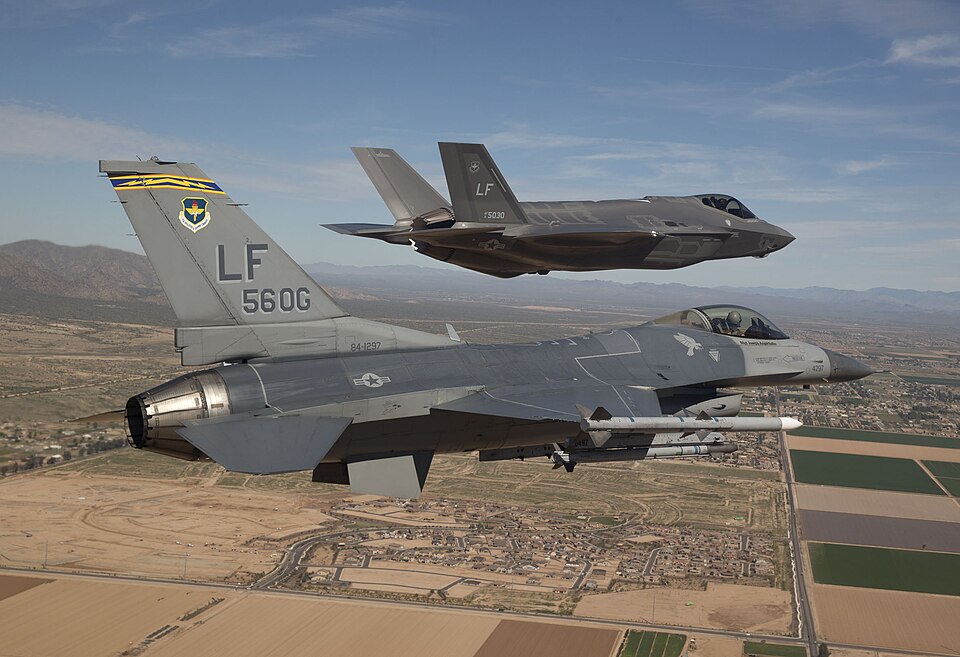
Luke Air Force Base has moved under Air Combat Command, a major organizational change that places the West Valley installation and its fighter-training mission directly under the Air Force command responsible for preparing combat airpower for operations.
The 56th Fighter Wing formally transferred from Air Education and Training Command, or AETC, to Air Combat Command, or ACC, on July 17. The move is part of a broader Air Force realignment announced in May that shifts combat-aircraft formal training units closer to the operational commands that ultimately use the pilots and aircraft they produce.
For West Valley residents, the immediate effect is more subtle than a base expansion or a new aircraft announcement. Luke is still a fighter-training base, its F-35A and F-16 training missions continue, and the Air Force has not announced that the command change by itself will add aircraft, personnel or flights. What changes is who controls the training enterprise and what Luke’s training is designed to connect to most directly.
What actually changed at Luke
Under AETC, Luke belonged to the Air Force command responsible for education and training across the service. Under ACC, the 56th Fighter Wing now sits inside the command responsible for organizing, training and equipping combat air forces.
The Air Force said the purpose is to bring front-line tactics into the formal training pipeline faster. AETC will continue providing foundational pilot and maintenance training, while ACC will have greater control over the advanced, aircraft-specific training that prepares Airmen for operational fighter units.
Luke is one of several combat-air-force formal training organizations making the same transition. The Air Force identified F-35 training at Luke and Eglin Air Force Base, F-16 training at Holloman Air Force Base and Morris Field in Tucson, and other fighter and remotely piloted aircraft units for reassignment.
The 56th Fighter Wing is unusually significant within that system. At the July transition ceremony, the Air Force described it as its largest fighter wing, with 27 squadrons, more than 7,000 base personnel and F-35A and F-16 missions involving more than $13 billion in assets. Luke also trains pilots from allied nations.
Training could become more closely tied to current combat requirements
The most concrete operational change is the connection between Luke’s classrooms, simulators, maintenance operations and flying squadrons and the units that employ those skills in combat.
Air Force Chief of Staff Gen. Ken Wilsbach said when the realignment was announced that ACC would be able to incorporate front-line tactics directly into the training pipeline. That can shorten the institutional distance between lessons learned by operational fighter units and what new F-35 and F-16 pilots are taught before reaching those units.
Luke’s new chain of command also connects it to 15th Air Force. Days after the reassignment, 15th Air Force leaders visited Luke and reviewed areas including mission-ready Airman training and the 56th Range Management Office. Luke officials said the range office manages about 11 million acres of airspace used for fighter training.
What West Valley residents could notice
The command transfer does not automatically mean more fighter flights over Glendale, Goodyear, Surprise, Litchfield Park or other communities around Luke. No official announcement reviewed by West Valley Post establishes a new sortie count, additional fighter squadrons or an increase in the base’s authorized aircraft because of the ACC move.
Over time, however, ACC control could influence the type and intensity of training conducted at Luke as the command adapts the fighter-training syllabus to operational requirements. If that eventually produces changes in flying schedules, exercises or use of regional training airspace, those decisions could have practical consequences for communities around the base. Such changes would need to be evaluated from future Air Force plans rather than assumed from the command transfer itself.
The same distinction applies to growth. Luke already represents a major concentration of military personnel, contractors, infrastructure and aviation activity in the West Valley. Moving the wing to ACC does not itself create thousands of new jobs or authorize a construction program. But it places Luke more directly inside the Air Force’s combat-airpower structure at a time when the service is emphasizing readiness, fifth-generation aircraft and preparation for high-end conflict.
Why the change matters for Luke’s long-term role
Luke’s central mission remains training fighter pilots, particularly F-35 pilots. The difference is that the Air Force now treats that advanced fighter-training enterprise as part of the same command structure responsible for combat aviation rather than primarily as part of its broader education system.
That could matter when future decisions are made about training capacity, ranges, simulators, facilities, maintenance resources and the evolution of the F-35 enterprise. It does not guarantee that Luke receives additional missions or investment, but ACC will now make those decisions with Luke inside its own operational training structure.
The change also reinforces the importance of the land and airspace surrounding Luke. West Valley cities and Maricopa County have long planned around the base’s flight corridors and noise contours, while development pressure continues across the region. A base whose training is being tied more directly to current combat requirements gives local governments another reason to preserve compatible land uses around Luke and its training routes.
What to watch next
The clearest signs of whether the ACC transition produces a visible West Valley effect will come from future Air Force decisions: changes in Luke’s aircraft inventory or squadron structure, military construction funding, training sortie levels, range investments, staffing and changes to flying or exercise schedules.
For now, the July 17 reassignment is primarily a command-and-training change rather than a physical expansion of Luke. Its significance is longer term: the West Valley’s largest military installation is now organizationally closer to the Air Force units preparing for and conducting combat operations, while retaining its role as one of the service’s most important fighter-training centers.
Sources: U.S. Air Force, 56th Fighter Wing Public Affairs and Air Combat Command. U.S. Air Force reporting on the July 17 reassignment and the May 11 combat-training realignment was used for this report.



Comments
Join the conversation. Keep comments relevant, civil and focused on the story.