


GLENDALE, Ariz. | Nov. 1, 2026. Glendale has approved the annexation and rezoning of approximately 160 acres for Project Eagle and Project Baccara near Luke Air Force Base. The City Council voted 6-1 on October 27, allowing the proposed campus of three data centers, a natural-gas power plant and electrical infrastructure to move into the next permitting stage. The vote was consequential, but it did not authorize every remaining construction or operating permit.
The property lies north of Olive Avenue, west of Litchfield Road near the 143rd Avenue alignment, on land formerly under Maricopa County jurisdiction. Residents in nearby Surprise, Waddell and unincorporated neighborhoods have questioned the plant’s emissions, water supply, noise, lighting and fuel storage. Supporters point to industrial zoning history, restrictions on housing near Luke, investment, jobs and potential revenue. The most useful answers are in the underlying county, state, Glendale and Air Force records, which do not always use the same figures or describe the same development phase.
Project Eagle refers to the data-center development; Project Baccara is the natural-gas generation facility. Takanock is associated with the campus; project records identify Baccara Eagle Land LLC as the property owner and Baccara Power LLC as applicant for the generating facility. The latest city plan calls for three data-center buildings, even though older presentations and some news stories still refer to two.
Project Eagle at a glance
| Question | Public-record answer |
|---|---|
| Where? | About 160 acres north of Olive Avenue between Reems and Litchfield roads, near Luke Air Force Base |
| Buildings | Three one-story data centers, approximately 1.08 million square feet in the zoning narrative; the September fiscal analysis models 1,121,681 square feet |
| Power generation | 18 natural-gas turbines rated at roughly 700 MW combined; the county’s summer-output estimate was 535 MW |
| Future power connection | Planned APS substation and grid interconnection, with the substation projected around 2030 in planning materials |
| Water | Developer forecast of roughly 116–120 acre-feet per year, about 38–39 million gallons; an earlier assessment estimated 180 acre-feet |
| Land-use status | Glendale annexation AN-273 and zoning ZON26-05 approved October 27, 2026; remaining approvals and construction still ahead |
The sections below distinguish modeled results from observed impacts, developer projections from enforceable conditions, and military compatibility from unconditional approval.
What Project Eagle would include
The final Glendale planning record describes three one-story data-center buildings totaling roughly 1.08 million square feet. A September fiscal analysis instead lists 1,121,681 square feet, reflecting a different planning assumption; both sources describe three buildings on the same overall site. Earlier Arizona Corporation Commission materials referred to two buildings, but the later Glendale zoning plan controls the current land-use concept. City reporting places the data centers on about 108 acres, the gas plant on roughly 33 acres and the future substation on approximately 12 acres; those are approximate component areas, not separate approved subdivisions.
The campus plan also includes:
- 18 natural-gas combustion turbines with stacks up to 72 feet tall.
- A generating plant rated at approximately 700 megawatts, with a 700.2-megawatt figure used in the state certificate.
- Four emergency diesel “black start” generators.
- Backup propane equipment and fuel infrastructure.
- An Arizona Public Service substation and transmission equipment.
- Chillers, electrical yards, water and wastewater facilities, security, parking and internal roads.
The data centers and power plant are separate parts of one coordinated campus. The July zoning narrative says a portion of the turbines would run continuously to supply the first data centers until APS completes the planned substation and transmission connections. Afterward the generating plant could operate intermittently for backup power or grid sales. The September fiscal analysis models the plant selling wholesale electricity to Electric District No. 7, with the district reselling it to the data centers. Glendale’s later FAQ instead describes primary power through APS infrastructure. Those descriptions concern different infrastructure stages and commercial arrangements, and the final agreements should establish the actual sequence and who buys the electricity.
Why that distinction matters: describing the plant as only an emergency backup source understates the possibility of routine operation in the early years. Describing 700 megawatts as the power it will constantly generate overstates what a nameplate figure proves. The county’s 535-MW summer peak estimate accounts for performance differences in hot conditions, and actual annual generation will depend on equipment dispatch and permitted operating hours.
The Arizona Corporation Commission approved a Certificate of Environmental Compatibility for the power plant on Feb. 4. That approval addressed the generating facility and interconnection, not the data centers or every local permit.
What Glendale approved, and what it did not
The Oct. 27 council action brought approximately 160 acres into Glendale and replaced the county Heavy Industrial zoning with a project-specific Planned Area Development.
The approved zoning establishes permitted uses, building standards and 12 conditions. Those conditions address air monitoring, traffic, emergency response, fuel systems, Luke AFB compatibility and other site requirements.
Project Eagle still needs detailed design review, building and infrastructure permits, final utility arrangements, fire and hazardous-material planning and any outstanding air or environmental approvals. Physical site work, not the zoning vote, will establish a verified construction start.
Luke Air Force Base gave conditional, not blanket, approval
The site lies within Luke’s 75- and 80-decibel day-night noise contours and within a critical arrival and departure area. State law restricts new homes in this area but allows certain nonresidential uses after military-compatibility review.
Luke’s March 13 compatibility review found the proposed uses incompatible unless specific conditions were satisfied. Its later June 30 letter to Glendale again stated that the development was not compatible with the base’s high-noise and accident-potential environment unless the listed conditions were met. Maricopa County incorporated requirements into military-compatibility permit MCP250007, which the Board of Supervisors approved 4-1 on May 6; Glendale’s zoning adds compliance with the June letter. The base expressly said it is not the final land-use approval authority.
The conditions require the developer to demonstrate that the project will not interfere with radar, communications or aircraft operations. Before permits and occupancy, the record calls for FAA and FCC documentation, electromagnetic-interference analysis, glare and exhaust-plume studies, air-permit compliance, fire and explosion planning, sound attenuation and Department of Defense review.
Outdoor lighting is planned with downward-directed cutoff fixtures. Applicant materials say mirrored glass, solar panels and other reflective materials would not be used. Shielded security lighting can reduce spillover but will not eliminate every view of nighttime illumination. If Luke, the FAA or another agency later identifies visual, atmospheric or electronic interference, the operator must correct it or risk violating the approval.
That distinction matters. Luke did not conclude that every final design detail already complies. It set conditions that must be demonstrated as the project moves through design and permitting.
Air quality: what the turbines may emit, and what a permit actually means
The plant would burn pipeline natural gas with propane as a backup fuel. The 18 turbines, four diesel black-start generators and fuel-storage equipment are relevant emission sources. The campus’s own backup generators also require separate consideration. Natural-gas combustion releases nitrogen oxides (NOx), carbon monoxide, particulate matter and carbon dioxide. NOx contributes to ozone formation, an important concern in the Phoenix region. The amount residents might encounter depends on actual emissions, distance, weather, background pollution and time spent running the equipment.
The project’s 2025 county air-permit application contained the following potential-to-emit estimates in tons per year. These are modeled annual figures under assumed controls and operating limits, not measured releases from an operating facility and not necessarily the final permitted totals.
| Pollutant | Modeled tons/year | What it means |
|---|---|---|
| Nitrogen oxides (NOx) | 89.9 | Can contribute to ground-level ozone formation |
| Carbon monoxide | 79.8 | Combustion-related air pollutant |
| Volatile organic compounds | 37.5 | Can contribute to ozone under suitable atmospheric conditions |
| Particulate matter PM10 | 61.3 | Inhalable particles, including larger fine-particle fractions |
| Fine particulate matter PM2.5 | 61.3 | Small airborne particles with health relevance |
| Sulfur oxides | 12.4 | Combustion-related sulfur pollutants |
| Hazardous air pollutants | 7.35 | Combined estimate for the regulated hazardous-pollutant category |
The application proposes selective catalytic reduction and oxidation-catalyst systems to reduce turbine emissions, along with emissions limits and monitoring. Those figures fall below the federal major-source thresholds identified in the application for several categories, while exceeding lower thresholds that trigger additional review, modeling or control requirements. None of those distinctions means zero pollution.
Permit status, as of the city’s October 29 FAQ: Glendale says the power plant has an air-quality permit, while the data-center component was still seeking its permit. That supersedes older documents saying the power-plant permit was pending. Glendale’s approved stipulations call for continuous emissions monitoring under the applicable county, state and federal permitting framework.
The remaining environmental accountability questions are concrete: What are the final enforceable limits for each emission source? Will the plant run regularly before the substation is available? How are the plant and co-located data-center sources evaluated together? What do compliance records show once turbines operate? The permit and later monitoring reports can answer far more than promises of perfectly clean air or predictions of certain illnesses.
Noise: the modeled result and its limits
Residents asking whether they will hear the plant need to separate average predicted operating noise from short turbine starts, maintenance, construction work and the pre-existing military aircraft sound. A-weighted decibels (dBA) approximate human hearing sensitivity, but a single number cannot capture tone or how intrusive a persistent low-frequency hum may feel.
A developer-commissioned operational-noise study measured existing sound at three locations for one 24-hour period in August 2025. It modeled all 18 turbines, four emergency generators, chillers and the future substation.
The developer-commissioned study estimated project-only sound of 45.9 dBA at scattered residences south along 143rd Avenue and 41.2 dBA north along 144th Drive. At the southern location, the lowest nighttime ambient measurement was 48.3 dBA; the model projected a combined 50.3 dBA, or a 2.0 dBA increase. To the north, it projected 43.5 dBA ambient rising to 45.5 dBA, also a 2.0 dBA change. Other periods yielded modeled increases of about 0.1 to 1.1 dBA. The study classified these increases as below its 3-dBA significance threshold.
The study assumed full-load operation and did not credit future walls or berms for additional sound reduction. However, it used a single day of ambient measurements and primarily evaluated steady operational noise. Organized opponents say that leaves uncertainty about unusual startup, shutdown and maintenance events and about whether one August day represents quieter conditions throughout the year.
Residents should read the modeled figures as a forecast based on specified assumptions, not a guarantee of what every home will hear. Final equipment, shielding, operating patterns and real-world monitoring will determine the actual effect.
Water: why several different numbers appear in the debate
The latest project estimates describe total annual demand of roughly 116–120 acre-feet, equivalent to about 37.8–39.1 million gallons. This is for the combined campus and power plant, not only the three data centers. At a December 3, 2025 state hearing, project engineer Scott McCleod explained that approximately 100 acre-feet would serve the turbines’ inlet-air cooling. The rest would support building occupants, data-center humidity control, initial filling of closed-loop cooling systems and maintenance.
An older groundwater-availability assessment had put project demand at 180 acre-feet per year, roughly 58.6 million gallons. When committee members questioned the discrepancy, the engineer described the 117–120 acre-foot estimate as the updated engineering breakdown. Both figures should remain visible in the public record; the later estimate has not yet been confirmed through actual measured use.
The developer’s design uses air-cooled and closed-loop systems for the data centers, which circulate water instead of relying on conventional continuous evaporative cooling. The turbine inlet-air cooling still consumes water, particularly in very hot weather. In other words, the low-water design of the computing buildings does not remove the generating plant’s demand.
Where could the water come from?
Glendale’s October 29 FAQ confirms that EPCOR, not Glendale’s municipal utility, will be the water and sewer service provider. Project engineers describe three potential supply streams: EPCOR potable service, treated wastewater from nearby Mark Anthony Brewing, and an on-site groundwater well as supplemental or contingency supply. The application described a letter of intent for the brewery arrangement. That does not prove a final operating contract or pipeline has been completed.
At the hearing, McCleod said the property then had an irrigation groundwater right of approximately 708 acre-feet per year, and that conversion to a Type 1 non-irrigation right was expected to result in approximately 382 acre-feet annually. He described the proposed well as a fallback if recycled water or another expected source became unavailable. Those figures describe water rights and a proposed conversion, not what the project is expected to pump every year.
Does the development use less water than the former rose farm?
The answer depends on which years, and which sources of agricultural water, are compared. In the same December hearing, McCleod said agricultural groundwater withdrawals averaged about 126 acre-feet per year when counting a period that included five non-irrigated years. In the years with irrigation, groundwater withdrawals averaged about 237 acre-feet. He also said that accounting excluded additional surface water supplied through an irrigation district.
That makes the claim of lower water use plausible for actively irrigated agricultural years, but the comparison is sensitive to baseline choices. Comparing projected project water against 237 acre-feet of irrigated-year groundwater gives a different percentage than comparing it against the 126-acre-foot longer-run average; including surface water changes the picture again. Neither comparison establishes that groundwater pumping after development will be zero.
Readers can check these figures in the December 3 evidentiary transcript, pages 598–610. The decisive next evidence will be finalized water agreements, groundwater well authorization and actual withdrawals once the campus operates.
Fire, fuel and emergency response
At the planning hearing, the developer’s attorney described about 450,000 gallons of backup propane in underground tanks. Glendale’s October 29 FAQ repeats that approximate quantity. This is propane, not natural gas: natural gas would arrive by pipeline. Tanks, fuel systems, batteries and major electrical equipment require a specific hazard and fire-response design, especially in an aviation accident-potential zone. The quantity by itself does not determine the likelihood of an incident.
The site plan uses an underground pipeline for natural gas. Backup propane plans have evolved, with the developer exploring a lateral connection to the neighboring Plains terminal to reduce truck deliveries and on-site storage.
Luke and county conditions require fire, explosion and aircraft-impact planning. Glendale added a 12th zoning stipulation requiring an agreement for the developer to contribute toward specialized emergency and hazardous-material response before the first certificate of occupancy.
The project must also provide fire access, inspections and confirmation that the responsible fire authority can serve the facility. These requirements recognize that a large generating plant, fuel systems, batteries and data-center electrical equipment create response needs beyond those of a conventional warehouse.
Light, wildlife, drainage and the physical site
Approved building standards allow data-center structures up to approximately 60 feet and turbine stacks up to 72 feet. The plan calls for at least eight-foot solid screening along northern and eastern boundaries, with anti-climb fencing and landscaping elsewhere. These measures can screen some ground-level views without making the facility or future transmission equipment invisible. The finished site will be a substantial visual change from farmland, even in an industrially zoned area.
The property is mostly agricultural and already carries industrial-entitlement history. Maricopa County approved heavy-industrial zoning for a grain-processing project in 1999, but that project was never built.
An Arizona Game and Fish screening report found no designated special areas within the project vicinity. It did identify documented special-status species within three miles, including western burrowing owl, Swainson’s hawk, cactus wren and lowland leopard frog, and predicted habitat ranges for additional species that could intersect the footprint.
The screening is an early planning tool, not a field survey proving that every listed species occupies the site. The record says additional coordination may be needed under state wildlife procedures, the Endangered Species Act or the National Environmental Policy Act, depending on later permits and federal involvement.
The county compatibility permit also requires final drainage, grading and infrastructure plans. The Air Force’s June 30 letter specifically warned that the private project should not assume it could discharge stormwater to the Luke-owned Dysart Drain, making a workable on-site drainage design an important remaining engineering issue. Residents near the site could experience the most visible short-term effects from construction traffic, dust, nighttime lighting and earthwork, while long-term operational impacts will require direct measurement.
Traffic and nearby residents
The council’s 12 stipulations also require an approved traffic study before design review, a fair-share agreement for the Hatcher/Reems signal before the first phase opens, a second emergency vehicle entrance, adequate firefighting water and specialized emergency-service funding. They impose measurable conditions; they do not establish that the improvements already exist.
Primary access is planned through an extension of Hatcher Road. Other concepts include a connection toward Peoria Avenue along the Bullard Road alignment and access to Olive Avenue across an existing rail easement.
Glendale requires an updated traffic-impact analysis before design review. The developer must also enter a development agreement addressing its share of a future signal at Hatcher and Reems roads.
Data centers generally employ fewer people per acre than offices or manufacturing plants, which can limit daily commuter traffic after opening. Construction will be different: a multiyear buildout involving turbines, data-center equipment, concrete, steel and utility work could create substantial truck activity. The final traffic study and construction-management plan will provide the most useful neighborhood-level forecast.
Jobs, investment, taxes and who benefits
There are materially different economic estimates in the record. An applicant economic presentation cited approximately 3,043 construction jobs, 330 permanent jobs at full operation and a $36.2 million annual payroll. Those are developer-facing projections, not guaranteed hiring commitments.
The separate September 2026 Glendale fiscal impact analysis intentionally modeled a more conservative 160 combined permanent positions, with an assumed average annual wage of $110,000. Its financial framework used approximately $1.3 billion in construction costs and $1.4 billion in initial equipment purchases. Some earlier project materials used substantially larger buildout investment assumptions; these should not be represented as one settled project price.
| September city fiscal scenario | Estimate |
|---|---|
| Combined data-center and plant jobs | 160 |
| Assumed average annual wage | $110,000 |
| Building and plant construction | $1.3 billion |
| Initial equipment purchases | $1.4 billion |
| Estimated one-time taxes and fees | $35.2 million |
| Estimated annual net effect on city operating funds | $10.3 million |
The report cautions that its estimates depend on electricity sales, prices, equipment tax treatment and final investment. Sales taxes on electricity are a particularly important assumed revenue source. Its estimate for routine municipal costs does not include a major unforeseen fire. Glendale has separately discussed more than $150 million in revenue over ten years, which is a city public statement under its assumptions rather than a guaranteed deposit.
The development may provide substantial construction work, relatively high-wage specialized jobs and a stronger tax base, while creating fewer permanent positions per dollar invested than many labor-intensive industries. Some nearby residents in Surprise or unincorporated Maricopa County would experience local effects while the direct municipal revenue accrues to Glendale. That geographic split is part of the opposition’s argument and is relevant to public accountability.
The proposed generating facility could also supply the regional grid under some operating arrangements. Whether that provides net reliability benefits, increases or reduces costs for ordinary customers, or leads to new ratepayer obligations depends on electrical agreements and regulatory treatment. Glendale’s FAQ explicitly refers questions about customer bills and reliability to APS. Approval alone cannot resolve them.
Why residents opposed it, and why officials approved it
Opponents organized petitions and repeatedly raised concerns about groundwater, air pollution, noise, fuel storage, fire safety, light, nearby homes and Luke’s mission. The April county staff report summarized 225 expressions of opposition and two of support in its record at that stage, including opposition letters and a petition. An additional Change.org campaign had thousands of listed signatures. These are records of submitted public comments, not a scientifically representative count of local residents or independently verified unique signers. The Stop Project Baccara campaign has argued that the proposed plant deserves more scrutiny because of its size and proximity to established neighborhoods.
Supporters and approving officials emphasized the site’s long-standing industrial zoning, the legal limits on residential development near Luke, private on-site power, jobs, tax revenue and the project’s acceptance of military, air-quality and emergency-response conditions.
The public dispute is partly about risk tolerance. The studies predict impacts within regulatory limits, while opponents question the assumptions and the wisdom of adding a large gas plant near existing homes and an active fighter base. The approvals resolve the land-use decision but do not erase that disagreement.
Project Eagle timeline
Each step below is a different approval or planning milestone. A recommended permit, a land-use vote and the start of excavation are not interchangeable.
- 1999: Maricopa County approves heavy-industrial zoning for a grain-processing project that is never built.
- August-September 2025: Project studies and permit applications address noise, air, water, wildlife and military compatibility.
- December 2025: The Arizona Power Plant and Transmission Line Siting Committee recommends the power-plant certificate 8-1.
- Feb. 4, 2026: The Arizona Corporation Commission approves the 700.2-megawatt Certificate of Environmental Compatibility 5-0.
- April 28: Glendale approves a pre-annexation development agreement.
- May 6: Maricopa County approves military-compatibility permit MCP250007 by a 4-1 vote, with conditions.
- June 30: Luke Air Force Base issues a further letter requiring conditions for military compatibility.
- July 17: Updated Glendale Planned Area Development narrative describes three data-center buildings and the power-generation schedule.
- Sept. 22: Glendale holds the annexation public hearing.
- Sept. 24: The Glendale Planning Commission recommends the rezoning 4-2.
- Oct. 27: Glendale City Council approves annexation Ordinance O26-38 and zoning Ordinance O26-39, both 6-1, with 12 zoning stipulations.
- Oct. 29: Glendale issues an updated FAQ distinguishing the power plant’s air permit from the data centers’ pending permit process.
- Around 2030: Applicant’s planning narrative projects completion of the utility substation, a milestone that may change the power plant’s operating schedule.
- Next: Detailed design, air and utility requirements, traffic analysis, fire and hazardous-material agreements, infrastructure permits and building permits.
Published schedules conflict. Some city reporting points to preliminary work beginning in November 2026 and a first building in 2028. The county narrative expected development to commence in 2027, while an economic study modeled a first building in 2029 and full buildout in 2030. Until permits and physical work confirm a schedule, those dates should be treated as planning targets.
West Valley Post will track permits, site work, the final air limits, water agreements, the data-center tenant, construction traffic and the first operating results. See the broader Loop 303 Development and Infrastructure Tracker for related corridor projects.
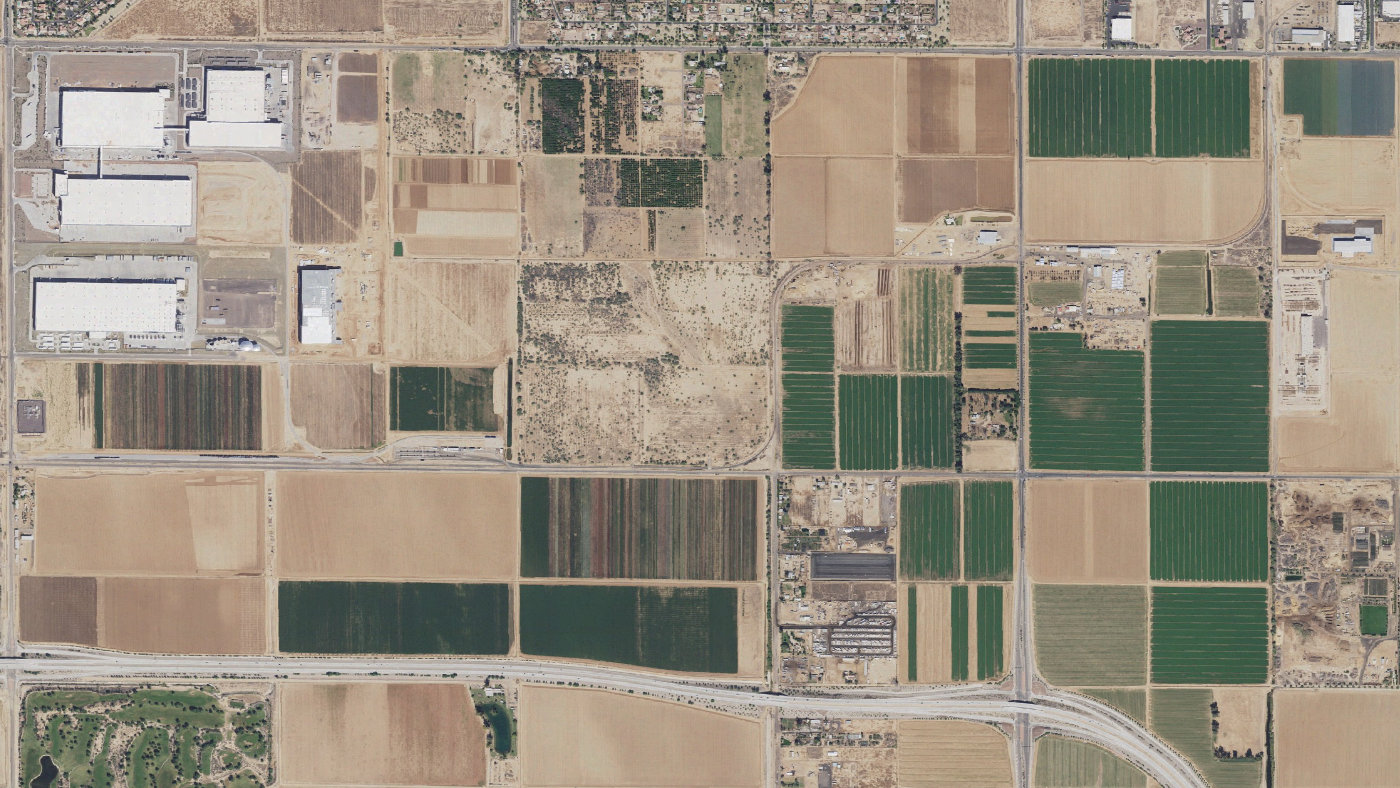
Featured image: Representative aerial imagery of the Olive Avenue and Litchfield Road area. It is not a site plan or project rendering. Credit: U.S. Geological Survey, The National Map.
Documents used for this guide
- Glendale’s Oct. 29 FAQ, including final 12 stipulations and air permit status
- Glendale City Council Oct. 27 agenda and ordinances
- Applicant’s July 17 zoning narrative
- Luke Air Force Base, June 30 letter
- Maricopa County military-compatibility staff report with air, noise, water and wildlife attachments
- Power Plant and Transmission Line Siting Committee, Dec. 3, 2025 sworn hearing testimony
- Arizona Corporation Commission, Feb. 4 certificate vote
- September 2026 fiscal analysis, with assumptions and caveats
- Organized opposition’s public campaign, for the opposition perspective
Source and methods note: Projected impacts reflect applicant/consultant estimates and agency reviews rather than independently observed operations. The water and jobs figures vary because different analyses used different assumptions. No site visit, interview or independent environmental measurement is claimed.


1 Comment
Join the conversation. Keep comments relevant, civil and focused on the story.