


Current guide: For the full post-approval record, including air-emission estimates, water sources, noise modeling, Luke Air Force Base conditions, community arguments and remaining permits, read Project Eagle and Baccara: Glendale approval, water, air and neighborhood impacts.
Updated Nov. 1, 2026: Glendale has approved the annexation and zoning framework for Project Eagle, a proposed 160-acre data-center campus and on-site natural-gas power plant near Luke Air Force Base. The Oct. 27 votes settle two major land-use questions, but they do not mean the campus is fully permitted or under construction.
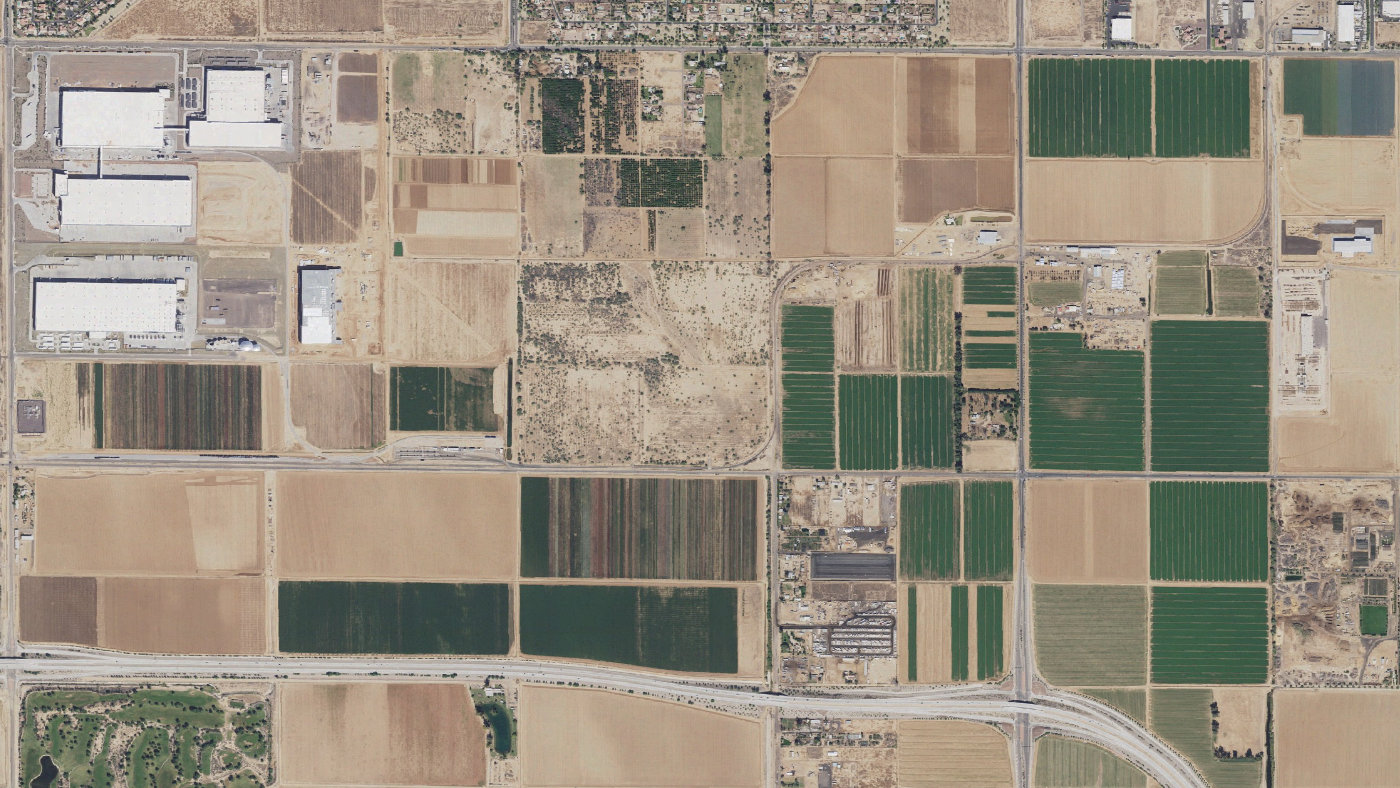
The project sits north of Olive Avenue between Reems Road and Litchfield Road, near the Bullard Avenue alignment and just north of Luke. Glendale City Council adopted annexation Ordinance O26-38 and rezoning Ordinance O26-39 by 6-1 votes. Councilmember Leandro Baldenegro cast the only no vote.
Project Eagle is the name used for the full Glendale development. Project Baccara, sometimes spelled “Bakara” in public discussion, is the name used in state and county records for the power-generation component. The owner is Baccara Eagle Land LLC, and project materials identify Takanock as the developer.
This guide explains what is proposed, what has been approved, what studies say about nearby impacts and which questions remain open.
What Project Eagle would include
The final Glendale planning record describes three one-story data-center buildings totaling roughly 1.08 million square feet. Earlier Arizona Corporation Commission materials referred to two buildings, but the later city zoning plan controls the current land-use concept.
The campus plan also includes:
- 18 natural-gas combustion turbines with stacks up to 72 feet tall.
- A generating plant rated at approximately 700 megawatts, with a 700.2-megawatt figure used in the state certificate.
- Four emergency diesel “black start” generators.
- Backup propane equipment and fuel infrastructure.
- An Arizona Public Service substation and transmission equipment.
- Chillers, electrical yards, water and wastewater facilities, security, parking and internal roads.
The data centers and power plant are separate parts of one coordinated campus. Project materials say the turbines would initially supply the data centers. The plant could later provide backup power, send excess electricity to the regional grid or do both after the APS substation and interconnection are complete.
The Arizona Corporation Commission approved a Certificate of Environmental Compatibility for the power plant on Feb. 4. That approval addressed the generating facility and interconnection, not the data centers or every local permit.
What Glendale approved, and what it did not
The Oct. 27 council action brought approximately 160 acres into Glendale and replaced the county Heavy Industrial zoning with a project-specific Planned Area Development.
The approved zoning establishes permitted uses, building standards and 12 conditions. Those conditions address air monitoring, traffic, emergency response, fuel systems, Luke AFB compatibility and other site requirements.
Project Eagle still needs detailed design review, building and infrastructure permits, final utility arrangements, fire and hazardous-material planning and any outstanding air or environmental approvals. Physical site work, not the zoning vote, will establish a verified construction start.
Luke Air Force Base gave conditional, not blanket, approval
The site lies within Luke’s 75- and 80-decibel day-night noise contours and within a critical arrival and departure area. State law restricts new homes in this area but allows certain nonresidential uses after military-compatibility review.
Luke’s March 13 review found the proposed uses incompatible unless specific conditions are met. Maricopa County incorporated those requirements into military-compatibility permit MCP250007, which the Board of Supervisors approved 4-1 on May 6.
The conditions require the developer to demonstrate that the project will not interfere with radar, communications or aircraft operations. Before permits and occupancy, the record calls for FAA and FCC documentation, electromagnetic-interference analysis, glare and exhaust-plume studies, air-permit compliance, fire and explosion planning, sound attenuation and Department of Defense review.
Outdoor lighting is planned with downward-directed cutoff fixtures. Applicant materials say mirrored glass, solar panels and other reflective materials would not be used. If Luke, the FAA or another agency later identifies visual, atmospheric or electronic interference, the operator must correct it or risk violating the approval.
That distinction matters. Luke did not conclude that every final design detail already complies. It set conditions that must be demonstrated as the project moves through design and permitting.
Air quality: what the permit application actually estimates
The turbines would burn pipeline natural gas, with propane as a backup fuel. Natural gas would not be stored on site. The conceptual plan also includes diesel tanks for the four emergency generators.
The project’s August 2025 air-permit application calculated annual “potential to emit” totals of 89.9 tons of nitrogen oxides, 79.8 tons of carbon monoxide, 37.5 tons of volatile organic compounds, 12.4 tons of sulfur oxides, 61.3 tons each of PM10 and PM2.5 particulate matter, and 7.35 tons of hazardous air pollutants.
Those are modeled maximum annual emissions under the application’s operating limits and pollution-control assumptions. They are not measurements from an operating plant. The application says the plant would remain below federal major-source thresholds for most criteria pollutants while exceeding several lower review thresholds that trigger best-available-control analysis, dispersion modeling and public notice.
The application calls for selective catalytic reduction and oxidation-catalyst controls on turbine emissions. Glendale’s zoning conditions require continuous emissions monitoring consistent with the Maricopa County air permit.
Project supporters point to the air-dispersion modeling and permit limits as evidence that the plant can operate within health standards. Opponents argue that another large combustion source is a poor fit for a county already struggling with ozone and particulate pollution. The decisive protections will be the final enforceable permit limits, monitoring data and agency enforcement after operations begin.
Noise: the modeled result and its limits
A developer-commissioned operational-noise study measured existing sound at three locations for one 24-hour period in August 2025. It modeled all 18 turbines, four emergency generators, chillers and the future substation.
The study estimated project-only sound of 45.9 decibels at scattered residences south of the site along 143rd Avenue and 41.2 decibels at neighborhoods north of the site along 144th Drive. When combined with the lowest measured hourly background levels, the model produced increases of 0.1 to 2 decibels, below the study’s 3-decibel significance threshold.
The study assumed full-load operation and did not credit future walls or berms for additional sound reduction. However, it used a single day of ambient measurements and primarily evaluated steady operational noise. Organized opponents say that leaves uncertainty about unusual startup, shutdown and maintenance events and about whether one August day represents quieter conditions throughout the year.
Residents should read the modeled figures as a forecast based on specified assumptions, not a guarantee of what every home will hear. Final equipment, shielding, operating patterns and real-world monitoring will determine the actual effect.
Water: a comparatively low estimate with unresolved sourcing details
County staff materials place the project’s maximum water demand at 116 acre-feet a year, about 37.8 million gallons. Staff said that would be less than half the irrigation groundwater rights associated with the property, which has been used for farming.
The developer plans closed-loop chilled-water cooling rather than water-intensive evaporative cooling. Application materials also identify EPCOR for potable water and sewer service and describe a letter of intent to receive recycled wastewater from nearby Mark Anthony Brewing. On-site groundwater could supplement other supplies within the property’s water rights.
Those components have been described differently at different stages. A February state presentation emphasized reclaimed wastewater and nearly zero groundwater, while later project materials retained wells and groundwater as possible supplemental sources. Final service agreements, well permits, reclaimed-water infrastructure and actual operating data will determine the water mix.
The approvals therefore support a projected demand, not a completed water-supply system. Water remains one of the most important items to verify before and after construction.
Fire, fuel and emergency response
The site plan uses an underground pipeline for natural gas. Backup propane plans have evolved, with the developer exploring a lateral connection to the neighboring Plains terminal to reduce truck deliveries and on-site storage.
Luke and county conditions require fire, explosion and aircraft-impact planning. Glendale added a 12th zoning stipulation requiring an agreement for the developer to contribute toward specialized emergency and hazardous-material response before the first certificate of occupancy.
The project must also provide fire access, inspections and confirmation that the responsible fire authority can serve the facility. These requirements recognize that a large generating plant, fuel systems, batteries and data-center electrical equipment create response needs beyond those of a conventional warehouse.
Light, wildlife and the physical site
The property is mostly agricultural and already carries industrial-entitlement history. Maricopa County approved heavy-industrial zoning for a grain-processing project in 1999, but that project was never built.
An Arizona Game and Fish screening report found no designated special areas within the project vicinity. It did identify documented special-status species within three miles, including western burrowing owl, Swainson’s hawk, cactus wren and lowland leopard frog, and predicted habitat ranges for additional species that could intersect the footprint.
The screening is an early planning tool, not a field survey proving that every listed species occupies the site. The record says additional coordination may be needed under state wildlife procedures, the Endangered Species Act or the National Environmental Policy Act, depending on later permits and federal involvement.
The county compatibility permit also requires final drainage, grading and infrastructure plans. Residents near the site should expect the most visible short-term impacts to come from construction traffic, dust, lighting and earthwork before the long-term operational effects can be measured.
Traffic and nearby residents
Primary access is planned through an extension of Hatcher Road. Other concepts include a connection toward Peoria Avenue along the Bullard Road alignment and access to Olive Avenue across an existing rail easement.
Glendale requires an updated traffic-impact analysis before design review. The developer must also enter a development agreement addressing its share of a future signal at Hatcher and Reems roads.
Data centers generally employ fewer people per acre than offices or manufacturing plants, which can limit daily commuter traffic after opening. Construction will be different: a multiyear buildout involving turbines, data-center equipment, concrete, steel and utility work could create substantial truck activity. The final traffic study and construction-management plan will provide the most useful neighborhood-level forecast.
Jobs, investment and public revenue
Applicant and city economic studies project approximately 3,043 direct construction jobs over the buildout and 330 permanent jobs at full operation, including about 300 data-center jobs and 30 power-plant jobs. The projected permanent payroll is approximately $36.2 million a year.
The application models roughly $10.2 billion in buildings, equipment and power-plant investment. A city fiscal analysis estimates approximately $35.2 million in one-time fees and an average annual net fiscal benefit of roughly $10.3 million under one set of assumptions.
Those are projections prepared for the project and city review. They are not guaranteed spending, hiring or tax receipts. Actual results will depend on the tenant, equipment purchases, construction schedule, tax treatment and operating level. Glendale officials have said the city is not providing a tax rebate or discount.
Why residents opposed it, and why officials approved it
Opponents organized petitions and repeatedly raised concerns about groundwater, air pollution, noise, fuel storage, fire safety, light, nearby homes and Luke’s mission. The April county staff report recorded two support letters, 84 opposition letters, a 141-signature petition and a Change.org petition with 4,171 signatures. Organizers later reported a larger online total, but petition counts do not independently verify residency or duplicate signers.
Supporters and approving officials emphasized the site’s long-standing industrial zoning, the legal limits on residential development near Luke, private on-site power, jobs, tax revenue and the project’s acceptance of military, air-quality and emergency-response conditions.
The public dispute is partly about risk tolerance. The studies predict impacts within regulatory limits, while opponents question the assumptions and the wisdom of adding a large gas plant near existing homes and an active fighter base. The approvals resolve the land-use decision but do not erase that disagreement.
Project Eagle timeline
- 1999: Maricopa County approves heavy-industrial zoning for a grain-processing project that is never built.
- August-September 2025: Project studies and permit applications address noise, air, water, wildlife and military compatibility.
- December 2025: The Arizona Power Plant and Transmission Line Siting Committee recommends the power-plant certificate 8-1.
- Feb. 4, 2026: The Arizona Corporation Commission approves the 700.2-megawatt Certificate of Environmental Compatibility 5-0.
- April 28: Glendale approves a pre-annexation development agreement.
- May 6: Maricopa County approves military-compatibility permit MCP250007 by a 4-1 vote, with conditions.
- Sept. 22: Glendale holds the annexation public hearing.
- Sept. 24: The Glendale Planning Commission recommends the rezoning 4-2.
- Oct. 27: Glendale City Council approves the annexation and PAD zoning 6-1.
- Next: Detailed design, air and utility requirements, traffic analysis, fire and hazardous-material agreements, infrastructure permits and building permits.
Published schedules conflict. Some city reporting points to preliminary work beginning in November 2026 and a first building in 2028. The county narrative expected development to commence in 2027, while an economic study modeled a first building in 2029 and full buildout in 2030. Until permits and physical work confirm a schedule, those dates should be treated as planning targets.
West Valley Post will track permits, site work, the final air limits, water agreements, the data-center tenant, construction traffic and the first operating results. See the broader Loop 303 Development and Infrastructure Tracker for related corridor projects.
Featured image: Representative aerial imagery of the Olive Avenue and Litchfield Road area. It is not a site plan or project rendering. Credit: U.S. Geological Survey, The National Map.
Correction, Oct. 28, 2026: An earlier version said the council-approved zoning carried 11 stipulations. Glendale’s final council item lists 12, including the developer agreement for specialized emergency and hazardous-material response described above.


Comments
Join the conversation. Keep comments relevant, civil and focused on the story.