



Analysis | Nov. 8, 2026. This article distinguishes enacted law, announced priorities and possible future policy changes. Election returns remain unofficial until canvassed.
A historic change, but not an overnight rewrite
Arizona’s Nov. 3 election has put Democrats on course to control the governor’s office and both legislative chambers for the first time since 1966. Gov. Katie Hobbs won reelection, Democrats secured both chambers, and the party’s candidates also won key statewide offices. The results remain unofficial until the state canvass scheduled for Nov. 23. The new Legislature convenes in January 2027. For West Valley residents, the central question is how a new governing majority will approach the region’s growth: new homes, water supplies, industrial campuses, utility costs, roads and the public services needed to support them.
Who will shape the decisions
Hobbs remains governor, while House Democrats selected Rep. Oscar De Los Santos as their incoming speaker on Nov. 6. De Los Santos has identified housing affordability, water protection, corporate landlords and data-center tax treatment as priorities. Senate Democratic leader Priya Sundareshan has also emphasized water and data-center guardrails. Attorney General Kris Mayes won reelection, giving the administration another statewide official with a role in environmental and consumer litigation. Newly elected Corporation Commission members Clara Pratte and Jonathon Hill will have a different responsibility: regulating investor-owned utilities, including decisions about rates and major infrastructure costs. None of those offices independently controls a city’s zoning map.
Housing: more pressure on prices, but which kind of reform?
Two different housing questions could reach the Capitol. One is supply: how easily builders can construct smaller homes, duplexes, townhomes and apartments. The other is cost and ownership: whether lawmakers change rules affecting institutional homebuyers, rental practices, housing assistance or affordability programs. De Los Santos has discussed restrictions on large corporate landlords and additional housing assistance, but the details and legislative support for new bills are not yet settled. Arizona already has bipartisan housing reforms on the books. A 2024 law requires qualifying municipalities to permit certain accessory dwelling units, while another requires qualifying cities to allow specified middle-housing types in defined circumstances. The new majority could amend, expand or revisit those laws, but their existing requirements do not disappear in January. Arizona also currently prohibits cities from imposing rent control on private residential housing; changing that statewide preemption would require legislation. Builders and local governments will be watching whether the new majority emphasizes faster approvals, stronger affordability conditions, tenant protections or some combination.
Will cities lose control of zoning?
Most individual rezoning decisions in Surprise, Buckeye, Peoria, Glendale, Goodyear and Avondale will still begin with city planning staff, commissions and elected councils. State lawmakers can set boundaries around municipal zoning powers, as the 2024 housing laws demonstrate. But the election itself does not rezone a parcel, approve a subdivision or authorize construction. A developer seeking a change from agricultural to industrial use, for example, still faces the applicable local process unless state law is changed. Expect debate over whether statewide housing standards should override local restrictions, and over how much discretion cities retain to negotiate roads, drainage, parks and infrastructure commitments. Hobbs’s April 2026 veto of SB1787 offers a concrete clue about her approach: she argued that the proposed changes to development exactions would not speed housing and said developers should pay their fair share for infrastructure. That is a stated position on one bill, not a complete blueprint for the next session.
Water may be the most consequential constraint
In fast-growing parts of the West Valley, access to legally adequate water can matter more than the party controlling the Legislature. The Arizona Department of Water Resources’ Phoenix Active Management Area modeling identified groundwater shortfalls over a 100-year projection and halted new assured-water-supply determinations based solely on groundwater in that area. Developments covered by existing certificates or designated providers can still proceed under applicable rules; other applicants may need alternative supplies. The department’s 2026 model update refined assumptions but continued to show unmet demand. For Buckeye, north Surprise and the outer growth corridor, future legislation could affect water credits, conservation, groundwater transfers, recharge, oversight and the cost of proving a long-term supply. Stronger safeguards could increase certainty for existing residents while making some marginal projects harder or more expensive. Conversely, workable new water-supply mechanisms could allow projects currently constrained by the rules to move forward. Neither result is guaranteed.
Industrial development and data centers
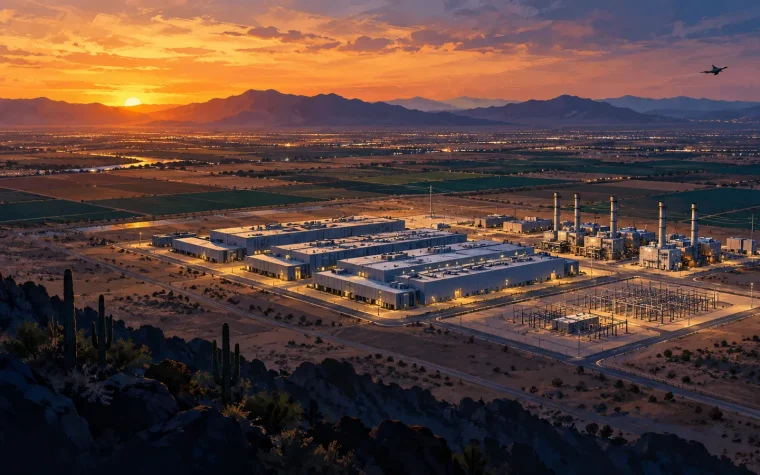
The West Valley’s industrial pipeline spans logistics, manufacturing, semiconductor suppliers, energy facilities and data centers. Those sectors have different land, workforce, water and electricity requirements, so a single statewide growth policy will not affect them equally. Data centers face particular scrutiny because of electricity demand, grid upgrades, water questions and tax incentives. One major change has already happened: Arizona’s enacted 2026 tax legislation bars new data centers from qualifying for specified state tax relief between July 1, 2026, and June 30, 2029. That restriction predates the Democratic election victory and should not be presented as a new administration proposal. De Los Santos has discussed limiting additional tax advantages. Pratte and Hill have called for deeper scrutiny of whether large electricity customers pay the costs they impose on the grid. Republican Commissioner Kevin Thompson defended the existing approach during the campaign, arguing that growth should pay for growth; APS disputed a consumer advocate’s analysis alleging that costs had shifted to other customers. That disagreement remains unresolved, and an election does not establish that the allegation is true. A separate question is whether lawmakers pursue siting, environmental or resource-use rules. Those would require actual proposals and decisions, not merely campaign rhetoric.
Electric bills and energy projects
The Arizona Corporation Commission’s new membership could matter directly to households and developers served by investor-owned utilities. Rate cases, transmission investments, large-customer tariffs and the treatment of renewable energy are areas to watch. The commission is not a statewide zoning board, and it does not regulate every municipal or public-power utility in the same way. A decision requiring a large new customer to bear more infrastructure cost might protect other ratepayers, but it could also alter the economics of a proposed facility. Cleaner generation and transmission investment could create new construction activity while raising separate land-use and permitting questions. Actual effects will depend on commission orders, utility filings and the service territory involved.
Roads and transportation: existing projects remain on the books
A new legislative majority can debate transportation appropriations and state priorities, but it does not automatically cancel the Loop 303, I-10 or State Route 30 work already programmed. ADOT’s State Transportation Board approved a roughly $11.3 billion 2027–2031 construction program in June 2026. The program includes projects developed with the Maricopa Association of Governments, and regional transportation funding also comes from voter-approved sales taxes. The West Valley’s I-10 widening work between Verrado Way and Citrus Road has already entered construction. Future budgets and program revisions could change the timing or scope of unfunded and later-stage projects; contracts and programmed funding deserve separate scrutiny. Residents should distinguish a transportation study, a funded design phase, an advertised construction contract and an active work zone.
What about taxes, incentives and attracting employers?
Arizona’s economic-development model includes workforce programs, infrastructure agreements and targeted tax provisions. A Democratic Legislature could revisit the balance between attracting investment and requiring public returns, especially for energy-intensive facilities and large employers. The 2026 tax legislation already adjusted manufacturing-related infrastructure funding while restricting new data-center tax relief. Business groups and Republican lawmakers may argue that additional costs or uncertain rules weaken Arizona’s competitiveness; Democrats and consumer advocates may argue that incentives need clearer accountability and that households should not subsidize private projects. Those are competing policy positions. The effects on a particular project will depend on the actual law, its effective date, any grandfathering provisions and the developer’s financing.
Schools, hospitals and neighborhood services
Growth is also a question of whether schools, emergency services, hospitals and utilities keep pace with new rooftops. The incoming majority has identified public-school investment as a priority, but spending decisions will face a constrained state budget. Changes to school funding could affect fast-growing districts such as Dysart and Peoria Unified, although local bond and override decisions remain separate. Hospital expansions, fire stations and city service facilities depend on a mix of private investment, local budgets, reimbursement systems and other funding. A change at the Capitol could influence these conditions without directly determining when a particular hospital wing or neighborhood school opens.
Which projects are most exposed?
Projects with final approvals, financing, utilities and construction underway are generally less sensitive to a future zoning debate than projects that still need legislative incentives, new water determinations, utility agreements or local rezoning. That distinction matters for Buckeye’s large master-planned developments, north Surprise commercial proposals and Glendale industrial sites. For example, Buckeye’s Teravalis framework was recommended by its planning commission in October, but a recommendation is not the same as final council approval. Glendale’s Project Eagle and Baccara approval likewise should be evaluated against its specific permit and utility requirements, rather than assumptions about a statewide political shift. Readers can follow those project records in West Valley Post’s development coverage.
What could slow the agenda?
Winning both chambers gives Democrats more control over committee hearings, bill calendars and the budget process, but it does not erase fiscal and legal limits. Arizona generally requires a two-thirds legislative vote for measures that increase state revenue under its constitutional rules, beyond the ordinary majority needed for many bills. The state also faces competing demands for schools, health care, transportation and other programs. New policies can face court challenges, administrative rulemaking and delays before they affect permits. Local elected officials and utilities retain important responsibilities. Republican legislators and business organizations will still be able to contest proposals publicly, negotiate amendments and challenge implementation.
The 2027 decisions to watch
The most useful test will be specific actions rather than party labels: the first housing and water bills introduced in January; committee assignments and budget proposals; any changes to corporate homeownership or rental rules; revisions to data-center incentives and utility tariffs; the Corporation Commission’s rate-case decisions; ADWR’s water determinations; and city-level votes on major West Valley rezoning requests. For residents, the question is not simply whether Arizona becomes more or less friendly to development. It is which kinds of development become easier to finance and approve, who pays for infrastructure, and whether water, roads, housing and public services can keep pace.
Primary records and reporting used
- Arizona election results, unofficial
- House speaker selection
- De Los Santos policy interview
- Arizona accessory dwelling unit law
- Arizona middle housing law
- Rent regulation preemption
- Hobbs veto letter on development exactions
- ADWR Phoenix AMA groundwater model
- 2026 enacted data-center tax moratorium
- Corporation Commission candidate positions
- ADOT five-year program
Related West Valley Post coverage
Featured photograph: Arizona State Capitol, photographed by Wikimedia Commons contributor Wars (August 2006), CC BY 2.5. Archival image.

Comments
Join the conversation. Keep comments relevant, civil and focused on the story.